The Great Migration: What Actually Happens, Month by Month
The migration is not an event you catch on a single date. It is a continuous circuit that never stops moving. Here is where the herds actually are through the year, and what that means for when you should travel.
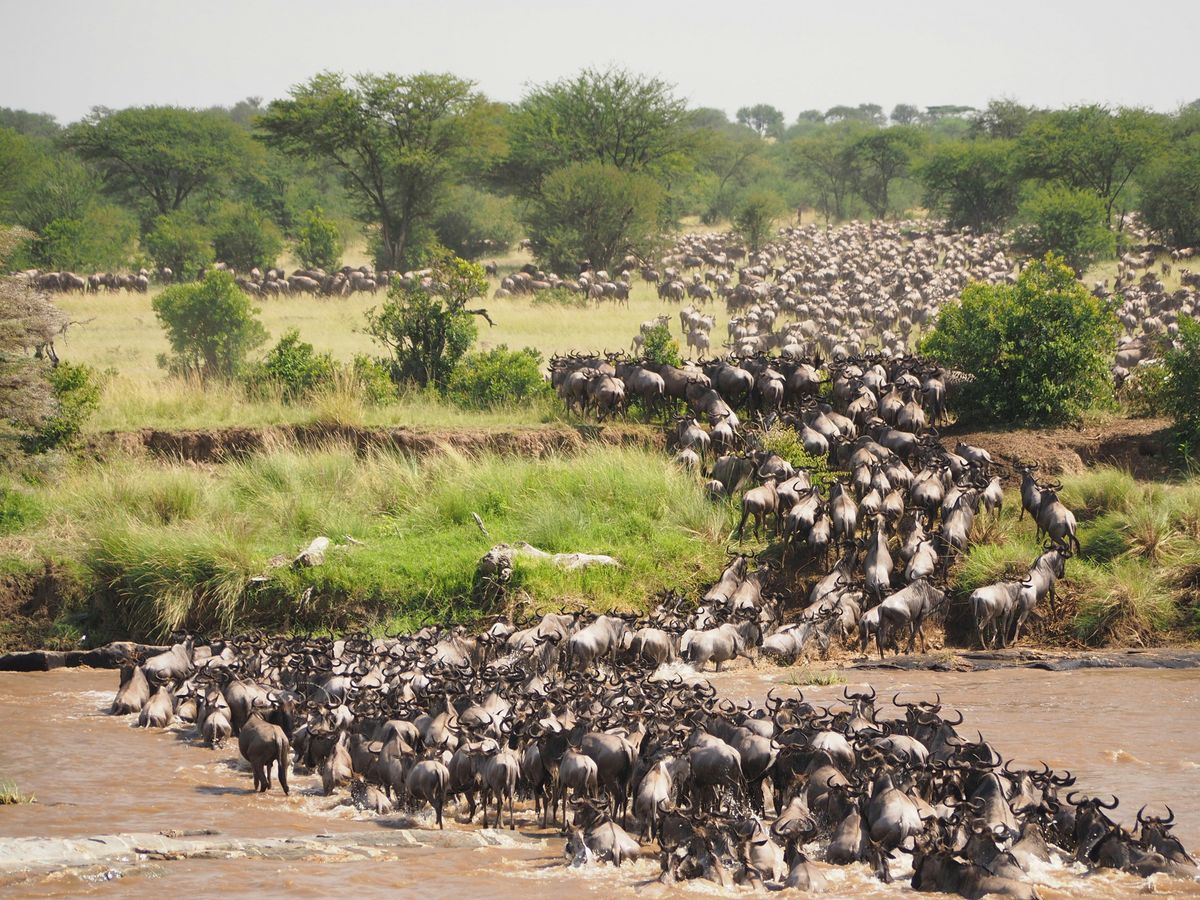
Most people picture the Great Migration as one dramatic scene: thousands of wildebeest hurling themselves into a crocodile-filled river. That scene is real. It is also perhaps two percent of what the migration actually is.
The migration never stops. Over a million wildebeest, together with hundreds of thousands of zebra and gazelle, move in a continuous loop through the Serengeti ecosystem, following rainfall and fresh grazing. They are not travelling to a destination. They are circling, permanently, and have been doing so for a very long time.
Understanding that changes how you plan. You are not trying to catch an event on a date. You are choosing which chapter of the circuit you want to witness.
January to March: the calving season
The herds gather on the short-grass plains of the southern Serengeti and the Ndutu area, which extends into the northern Ngorongoro Conservation Area. The volcanic soil here produces grass that is unusually rich in the minerals a nursing mother needs.
Then something extraordinary happens. Across a few weeks, roughly 8,000 calves are born per day.
This synchronised birthing is a survival strategy. By flooding the plains with newborns all at once, the herd guarantees that predators cannot possibly take them all. A wildebeest calf is on its feet within minutes of birth and running with the herd soon after.
For predator action, this is arguably the most productive time of year in the entire circuit. Lion, cheetah, and hyena concentrate around the calving grounds because the opportunity is unmissable.
Who this suits: photographers, anyone who wants intense predator activity, and travellers who prefer fewer vehicles than the July peak.
April to May: the long rains
The herds begin drifting west and north. This is Tanzania's wet season, grass grows long, and wildlife is harder to spot in the taller cover. Some camps close.
It is also the cheapest time to be in the Serengeti, and the landscape is green and dramatic rather than dusty. If your budget matters more than guaranteed sightings, this window is genuinely underrated.
May to July: the Grumeti River
As the herds push into the Western Corridor, they meet their first serious obstacle: the Grumeti River, and the very large Nile crocodiles that live in it.
The Grumeti crossings are less famous than the Mara crossings further north, and less predictable. The river here is often a series of pools and channels rather than one continuous barrier, so the drama is usually smaller in scale.
That is precisely why some travellers prefer it. Where a Mara crossing might draw thirty safari vehicles to one riverbank, the Grumeti typically draws far fewer. You trade spectacle for solitude.
Timing note: Grumeti crossings tend to happen in a compressed window, often only a week or two, somewhere in the May to July range. Exact timing follows the rains and cannot be forecast far ahead.
July to October: the Mara River crossings
This is the chapter that appears on every safari poster.
The herds reach the northern Serengeti and face the Mara River, the most serious barrier on the entire circuit. The crossings are frantic, confused, and genuinely difficult to watch at times. Animals drown. Crocodiles take what they can. Only a fraction of any herd crosses in an orderly way.
Crossings can begin as early as June and continue into October, but July and August are the reliable months. A common misconception is that the herds all leave for Kenya. In reality a substantial portion remains on the Tanzanian side throughout, in the Mara Serengeti region.
The honest trade-off: this is peak season. Prices are at their highest, camps book out a year ahead, and you will share sightings with other vehicles. You are paying a premium for the highest probability of the most dramatic scene in African wildlife.
October to December: the return south
The herds turn and move back down through the Loliondo region toward the central and eastern Serengeti. By November the short rains have begun and the herds arrive back on the southern short-grass plains, ready to start the cycle again in December.
November is a quiet, pleasant, and considerably cheaper time to be in the Serengeti.
The single most important thing to understand
Nobody can guarantee you a river crossing. Anyone who promises one is selling you something they cannot deliver.
The herds move according to rainfall, and rainfall varies year to year. A crossing might happen an hour after you arrive at the riverbank, or three days after you leave. Experienced guides improve your odds substantially because they know where the herds are today and how they have been behaving this week. But odds are not certainty.
The travellers who come away happiest are the ones who plan for the ecosystem rather than the event. The Serengeti at any time of year is one of the great wildlife destinations on Earth. A river crossing is a spectacular bonus, not the entire trip.
Practical planning
- Give yourself nights, not days. Three or four nights in one area dramatically improves your chances over a single overnight stop.
- Stay close to the action. In the north, camps near the Mara River put you a short drive from the crossing points. Mobile camps that move with the herds are the strongest option.
- Book early for July to October. Twelve months ahead is normal for the good camps in peak season.
- Consider the shoulders. June and November offer strong wildlife viewing at noticeably lower prices than the July to October peak.
A good Tanzanian operator will tell you honestly where the herds are likely to be during your dates, and will say so plainly if your timing does not suit what you are hoping to see. That honesty is worth more than any promise.
Safariconnect
Written in Tanzania
Plan this trip properly
Seven questions, a full day-by-day itinerary in under a minute, and a direct line to a verified Tanzanian operator. No commission, no middleman.
Start Planning