Ngorongoro Crater: The World Inside a Collapsed Volcano
A caldera nineteen kilometres across, walls six hundred metres high, and roughly 25,000 large animals that live inside it permanently. What makes Ngorongoro unlike anywhere else in Tanzania, and what to expect on the day.
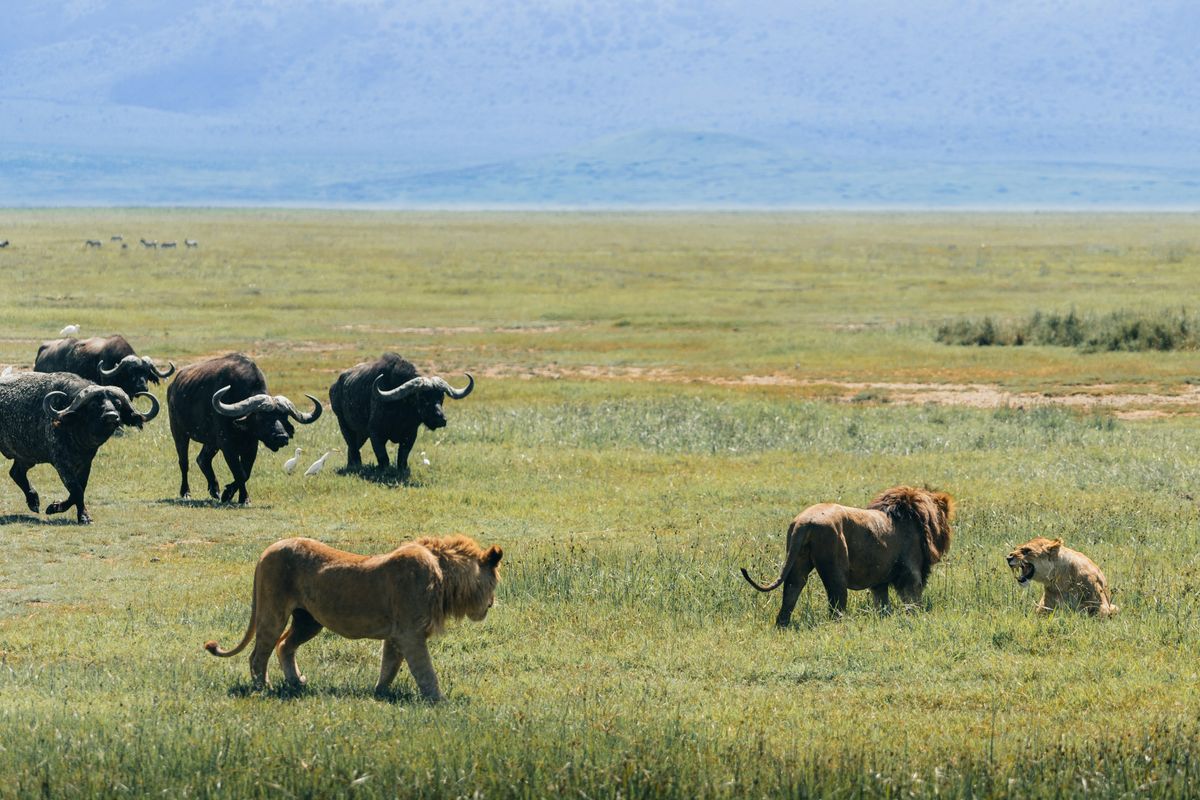
Around two and a half million years ago, a volcano roughly the size of Kilimanjaro erupted and then collapsed inward into its own emptied magma chamber.
What it left behind is the Ngorongoro Crater: the largest intact, unflooded volcanic caldera on Earth. It measures about nineteen kilometres across. The walls rise between four hundred and six hundred metres above the floor. The floor itself covers roughly 260 square kilometres.
And inside it lives one of the densest concentrations of large wildlife anywhere on the planet.
What lives down there
Approximately 25,000 large animals live on the crater floor, and most of them never leave. The walls are steep enough that the crater functions as a natural enclosure, though not a prison: animals can and do move in and out.
The rough composition, based on long-running counts:
- Around 7,000 wildebeest
- Around 4,000 zebra
- Around 3,000 eland
- Around 3,000 Grant's and Thomson's gazelle
- Over 4,000 buffalo
- Several hundred spotted hyena
- A few hundred elephant, concentrated around Lerai Forest
- Roughly 60 lion, one of the densest lion populations recorded anywhere
- Around 30 black rhino
Over 500 bird species have been recorded, and flamingos on the soda lake, Lake Magadi, can number in the hundreds of thousands during peak periods, turning the water visibly pink from the rim.
Two notable absentees: giraffe and impala. Giraffe cannot comfortably manage the steep descent, and the crater's habitat does not suit impala. It is one of the few places in East Africa where you will see the Big Five but not a giraffe.
Why people come: the black rhino
Ngorongoro is one of the most reliable places remaining in Tanzania to see a critically endangered black rhino in the wild.
The crater population is small, around thirty animals, and heavily protected by rangers. They tend to be found on the open grasslands, often at a distance, but they are there, and on a good day you will see one.
This is also the single most reliable place in Tanzania to see all of the Big Five, lion, leopard, elephant, buffalo, and rhino, on one game drive. The compact, enclosed geography is what makes that possible. In the vastness of the Serengeti, the same five species are spread across nearly 15,000 square kilometres.
A conservation story worth knowing
The crater's lions carry a difficult genetic legacy. In 1962, a biting fly epidemic devastated the population, and genetic studies indicate the current lions descend from as few as fifteen surviving individuals.
The result is a population with limited genetic diversity and documented inbreeding concerns, which conservationists monitor closely. It is a reminder that a place can look abundant and still be fragile.
What the day actually looks like
Ngorongoro is a day-trip destination. You sleep on the rim or in Karatu below it, descend in the morning, spend the day on the floor, and climb back out in the afternoon.
A strong routine looks roughly like this:
- Enter at first light. Gates open at 06:00. The early descent matters: you get the best light, the coolest air, and the most predator activity before the day warms.
- Head to the eastern plains for buffalo, wildebeest herds, and lion.
- Mid-morning at the hippo pool as the day heats up.
- Cross the floor through the open grassland, scanning the western section where rhino are often reported.
- Finish through Lerai Forest in the afternoon for elephant, particularly the old bulls, and a final check for lion.
A guide with long crater experience genuinely changes what you see. They know where the prides were yesterday, where rhino have been reported this week, and which pools are productive this season. This is one place where guide quality translates directly into sightings.
The Maasai, and why this is not a national park
Ngorongoro is a Conservation Area, not a national park, and the distinction is deliberate and important.
The Ngorongoro Conservation Area covers roughly 8,300 square kilometres, and the Maasai retain the right to live within it and graze their cattle alongside the wildlife. It is one of the few protected areas in Africa designed around coexistence rather than exclusion.
You will see Maasai herders moving cattle across the same landscape as zebra and wildebeest. That is not a failure of the park. That is the model.
The area was inscribed as a UNESCO World Heritage Site in 1979, recognised both for its natural value and for the Olduvai Gorge nearby, one of the most important sites in the study of human evolution. The 3.6 million year old Laetoli footprints found in the area are among the oldest known evidence of upright walking.
When to go
Because the wildlife stays in the crater year-round, timing matters less for what you will see and more for how many other vehicles you will share it with.
- June to October is the dry season and the busiest. Excellent viewing, most vehicles.
- November to May is greener and quieter. Elephant numbers on the floor tend to be higher in the wetter months.
The crater is compact, and on a busy day in high season you will see other vehicles at most good sightings. Going early is the most effective way to get ahead of that.
One honest caution
Ngorongoro is extraordinary, but it is intensively visited and it is not wilderness in the way the northern Serengeti is. Some travellers arrive expecting solitude and are surprised.
Set the expectation correctly and it is one of the most rewarding single days available anywhere in African wildlife travel. You are standing on the floor of a collapsed volcano, surrounded by animals, with six hundred metre walls rising around you. There is nowhere else quite like it.
Safariconnect
Written in Tanzania
Plan this trip properly
Seven questions, a full day-by-day itinerary in under a minute, and a direct line to a verified Tanzanian operator. No commission, no middleman.
Start Planning